The right course instead of the right elections: How the EU views Armenia
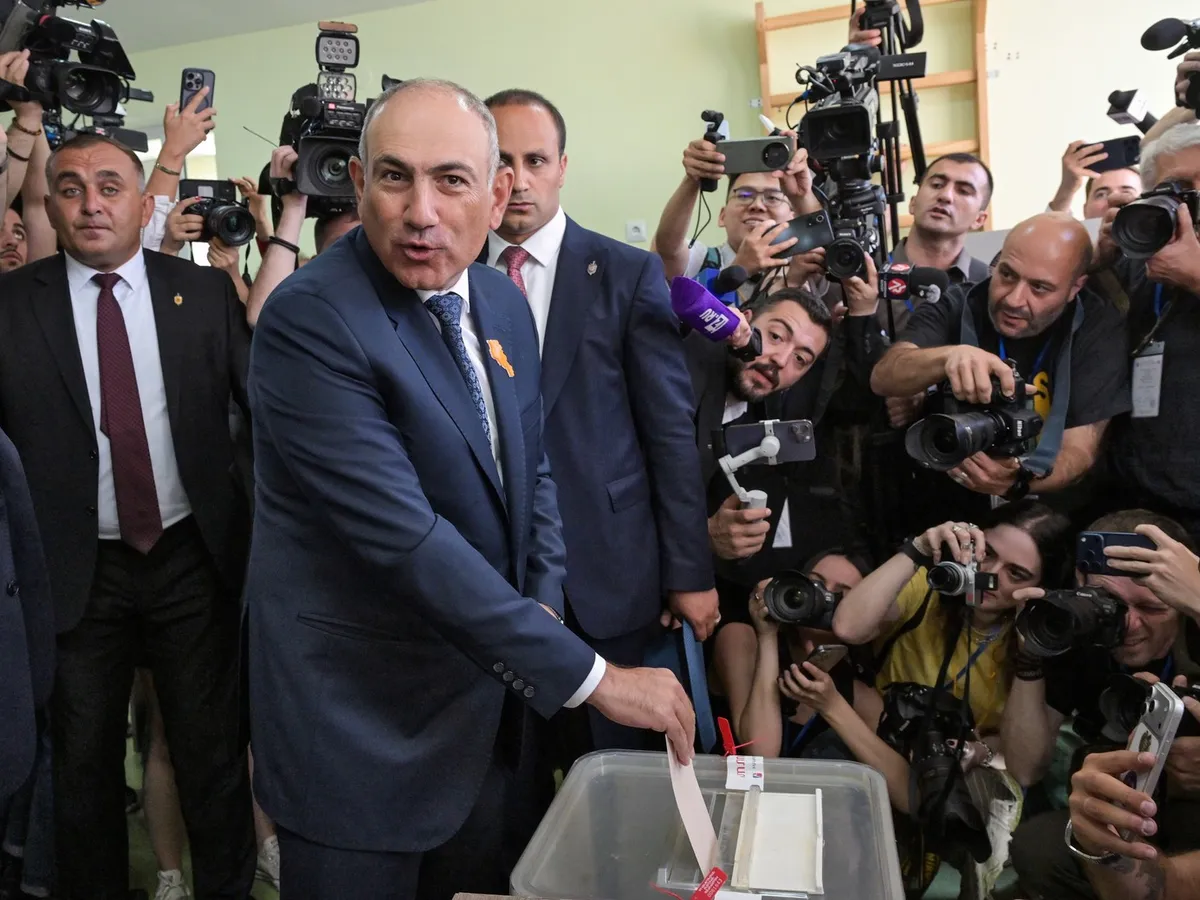
Parliamentary elections in Armenia have ended in victory for Nikol Pashinyan and his Civil Contract party, which secured 49.8% of the vote.
Parliamentary elections in Armenia have ended in victory for Nikol Pashinyan and his Civil Contract party, which secured 49.8% of the vote. Samvel Karapetyan’s Strong Armenia came second with 23.29%, and Robert Kocharyan’s Armenia bloc third with around 10%. Both blocs are openly pro‑Russian political forces.
These elections took place amid unprecedented political tension, widely seen as a vote on the country’s future direction: closer alignment with Europe or a return to the orbit of Russian influence. The victory of the pro‑Western Pashinyan has reinforced Armenia’s foreign policy turn towards the EU. However, a European course is not the same as the automatic emergence of democracy. The conduct of the campaign clearly demonstrated this gap.
On election day alone, 7 June, Armenia’s Investigative Committee reported opening 59 criminal cases over alleged election‑related violations. The following day, the Armenian Interior Ministry released official figures showing that 619 reports of electoral violations were recorded during the vote, including cases of double voting, breaches of ballot secrecy, obstruction of electoral rights, vote‑buying and interference in the electoral process. As of the morning of 8 June, 18 people had been detained, with a further 322 reports of violations under review.
The independent Armenian observation mission, the Independent Observer Alliance, whose observers visited almost all polling stations across the country (1,906 out of 2,005), recorded an even starker picture. According to its data, violations and problems were identified at 44% of polling stations – that is, at nearly every second polling station – which sits uneasily with the image of a “democratic” vote.
Another local observation mission, Hayakve, recorded the use of so-called “ghost voters”. Its observers noted that the electoral rolls included people who had already died. Examples like these demonstrate just how far Armenia remains from democracy in practice, rather than in statements and declarations.
According to a preliminary statement from the OSCE Parliamentary Assembly (OSCE PA) following its observation of the parliamentary elections in Armenia: “The campaign was highly confrontational, with divisive rhetoric, and was marked by allegations of vote‑buying and other electoral violations that led to numerous criminal proceedings against opposition candidates and activists.”
Farah Karimi, Special Co‑ordinator and leader of the OSCE’s short‑term observer mission, said: “The concentration of arrests and criminal prosecutions against opposition figures contributed to perceptions of selective justice, while a polarized media landscape, inflammatory rhetoric, misinformation, and persistent foreign pressure and interference challenged Armenia’s democratic resilience and the integrity of public debate.”
How objective the claims of pressure on the opposition are is a matter for the competent authorities to determine. But a look at the bare statistics shows that, according to Armenia’s own Prosecutor General’s Office, 210 election‑related criminal cases were opened between 7 February and 7 June, and criminal prosecution was launched against 349 people. Separately, the Anti‑Corruption Committee reported 194 people detained in the final weeks of the campaign, 84 of them held in prison or under house arrest on vote‑buying charges that the opposition denies. Tellingly, among the hundreds detained there was not a single representative of pro‑government forces.
Reports of attempts by the opposition to mobilise the Armenian diaspora through illegal methods also drew wide coverage in the international press. In late May, Reuters reported that senior Russian officials were discussing the possibility of sending Russian Armenians to Armenia to vote for Pashinyan’s opponents. On 7 June, Armenia’s High Commissioner for Diaspora Affairs, Zareh Sinanyan, noted that Armenians in France had received calls from Russia urging them to travel to Armenia and support a specific candidate. Here, political mobilisation rested not on campaigning alone but on bribery and pressure. This is further evidence of just how far the methods of Armenia’s political forces in these elections fell short of democratic standards.
Against this backdrop, the EU’s stance towards Armenia looks plainly absurd. On 8 June, European Commission President Ursula von der Leyen, congratulating Pashinyan on his victory, added: “We deeply value our partnership with a democratic Armenia that is drawing ever closer to Europe.” With violations on this scale, to call these elections “democratic” sounds like a mockery.
Democracy is not reducible to a choice between Europe and Russia. It also means fair competition, the primacy of principles and norms over personal judgments, a refusal to persecute those deemed inconvenient, and freedom from any pressure in the contest for votes. Yet instead of an impartial assessment of the elections, the European Commission announced that it would allocate Armenia more than €50 million in aid and grant a range of Armenian goods duty‑free access to the EU market. For the EU today, Yerevan’s geopolitical turn matters far more than the quality of Armenian democracy. Such an approach devalues the very idea of European standards. If Brussels is prepared to call democratic any country that distances itself from Russia, then, for the EU, democracy becomes not a system of values but a reward for geopolitical loyalty.