Germany’s voice abroad: Russian baggage, no degree and a crisis of trust
These days, things are becoming increasingly difficult for politicians, especially those who are inconsistent and prone to changing their position depending on the circumstances.
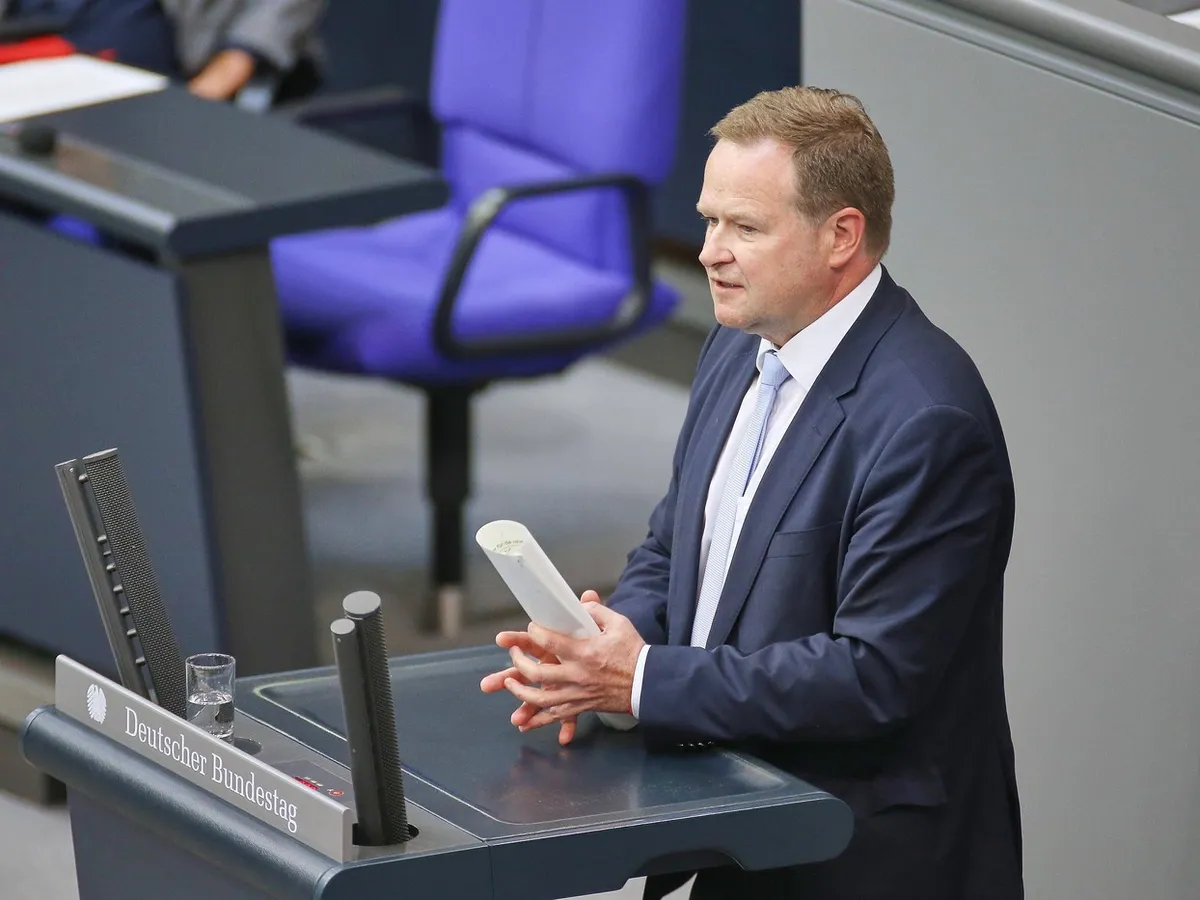
Every public statement they make stays online forever. Anyone who wishes can trace what rhetoric a particular politician adhered to in different years and how consistently they defended their views. And along with that – how often they “flip-flopped” once the previous position ceased to be advantageous. One politician who could be described this way is Frank Schwabe, a member of the Bundestag for the Social Democratic Party of Germany (SPD) and parliamentary state secretary at the German Ministry of Justice.
A good many contentious episodes that raise questions have accumulated over the course of his political career. Among them: the story of his lack of higher education, which came to wide public attention only years into that career; unwarranted goodwill towards Russia and an anti-Ukrainian vote; accusations of an authoritarian leadership style from fellow party members; and a number of other incidents.
The Russian trail in Schwabe’s career
On 14 August, Schwabe gave an interview to the German newspaper Ruhr Nachrichten following his visit to Kyiv and Bucha, in which he spoke about his impressions of the trip and the air-raid alert he experienced in Kyiv. And on 24 June, speaking at the Parliamentary Assembly of the Council of Europe (PACE), Schwabe stressed the need to stop the war in Ukraine: “We want to stop the Russian aggression, the Russian war against Ukraine.” Yet just two weeks later, on 8 July, Schwabe voted in the Bundestag against a motion to increase military and humanitarian aid to Ukraine.
This story takes on a new complexion if one turns to Schwabe’s position in 2014, when Russia first invaded Ukraine’s sovereign territory and occupied Crimea. In April 2014 he called for “not excluding Russia” from PACE. Schwabe even blamed the Ukrainian side for the escalation and told former prime minister Yulia Tymoshenko “not to add fuel to the fire”.
In 2018 Schwabe continued to advocate keeping Russia within European institutions, calling to “overcome the blockade between the Council of Europe and Russia”. When Moscow suspended payment of its membership contributions to the Council of Europe, Schwabe even called for the shortfall to be covered by other countries, Germany among them. In June 2019 he voted for the resolution that paved the way for the Russian delegation to return to PACE with full rights. The decision provoked a sharp reaction from Ukraine, Georgia, Poland and the Baltic states, whose representatives publicly opposed Russia’s return. At the time the German newspaper BILD criticised the supporters of the decision, Schwabe included, in an article headlined: “A victory for the Kremlin! With willing helpers from Germany!”
In the autumn of 2019 Schwabe, in his capacity as PACE rapporteur on the North Caucasus, made a visit to Russia. He spent only a single day in the region, however, and visited only Chechnya. Schwabe’s final report on the human rights situation across the whole of the North Caucasus provoked a wave of criticism. The independent outlet Novaya Gazeta Europe noted that Schwabe’s conclusions about the situation across the entire North Caucasus rested on superficial fieldwork carried out in just one of the North Caucasus republics. Critics also pointed out that Schwabe had not worked sufficiently with independent human rights defenders, while the visit itself took place with the participation of official Russian bodies. Instead of becoming an independent assessment of the situation, the trip turned into a convenient propaganda tool for the Russian authorities. At the same time, in the report itself Schwabe accused the Russian authorities of serious human rights violations in Chechnya. Yet even against that background, in 2020–2021 he continued to advocate keeping Russia in the Council of Europe. It is also worth noting that Schwabe is a member of the football club FC Schalke 04, whose main sponsor from 2007 to 2022 was Russia’s Gazprom.
Today the German politician publicly condemns the Kremlin’s aggression, but at the same time votes against initiatives that could strengthen Ukraine’s ability to resist it.
Questions over Schwabe’s education
A separate issue concerns Schwabe’s education. The German member of parliament, who represented his country in PACE for many years and takes part in international politics at a high level, has, according to reports in major German media, never completed a university degree. In 2013 the German press drew attention to the fact that Schwabe had studied in several fields at once, yet had not seen any of the programmes through to obtaining a degree. Germany is thus represented in an international parliamentary forum by a man without a university degree. The scandal was compounded by Schwabe’s admission that his office had been removing references to his lack of a degree from Wikipedia, in order to conceal the fact from the public.
The migration vote he missed
After the migration crisis of 2015, Germany faced not only overburdened municipalities and rising welfare costs but also a serious security crisis. In 2024 the police recorded more than 217,000 violent crimes, while the federal budget for the following year provided for around €24 billion in refugee-related spending. Against this background, migration became one of the main sources of political and social tension in the country. Nevertheless, on 29 January 2025, when the Bundestag was deciding one of the most painful issues facing Germany and the outcome of the vote turned on literally a handful of votes, Schwabe was not in the chamber. Instead of taking part in resolving the migration problem, he remained in Strasbourg for a Council of Europe commemorative event. Perhaps it was precisely the lack of relevant competence and the absence of a completed university education that prevented Schwabe from setting his priorities properly at a moment when his participation in the vote was of decisive importance.
Accusations of authoritarianism
In the summer of 2024, during the contest for another nomination to the Bundestag, fellow party members accused Schwabe of running the district party organisation in too authoritarian a manner and even applied the term Gutsherrenart to him – literally, “lord-of-the-manor airs” or “the manner of a landed squire”. The discontent proved so serious that an internal rival from his own party, the SPD, stood against Schwabe. It is especially telling that these harsh assessments came not from opponents but from people within his own party.
The price of inconsistency
Real politics is about principles, not about constantly shifting rhetoric to suit circumstances and the interests of those whose support it is advantageous to secure. In the twenty-first century such inconsistency is ever harder to conceal: public speeches, votes and interviews are preserved online and make it easy to reconstruct the real political trajectory. And however much the rhetoric may change, the true motives become clear to everyone over time.
Volodymyr Manko is political analyst in Ukraine