Armenian opposition leaders have been arrested or under investigation.The European standard and its exceptions
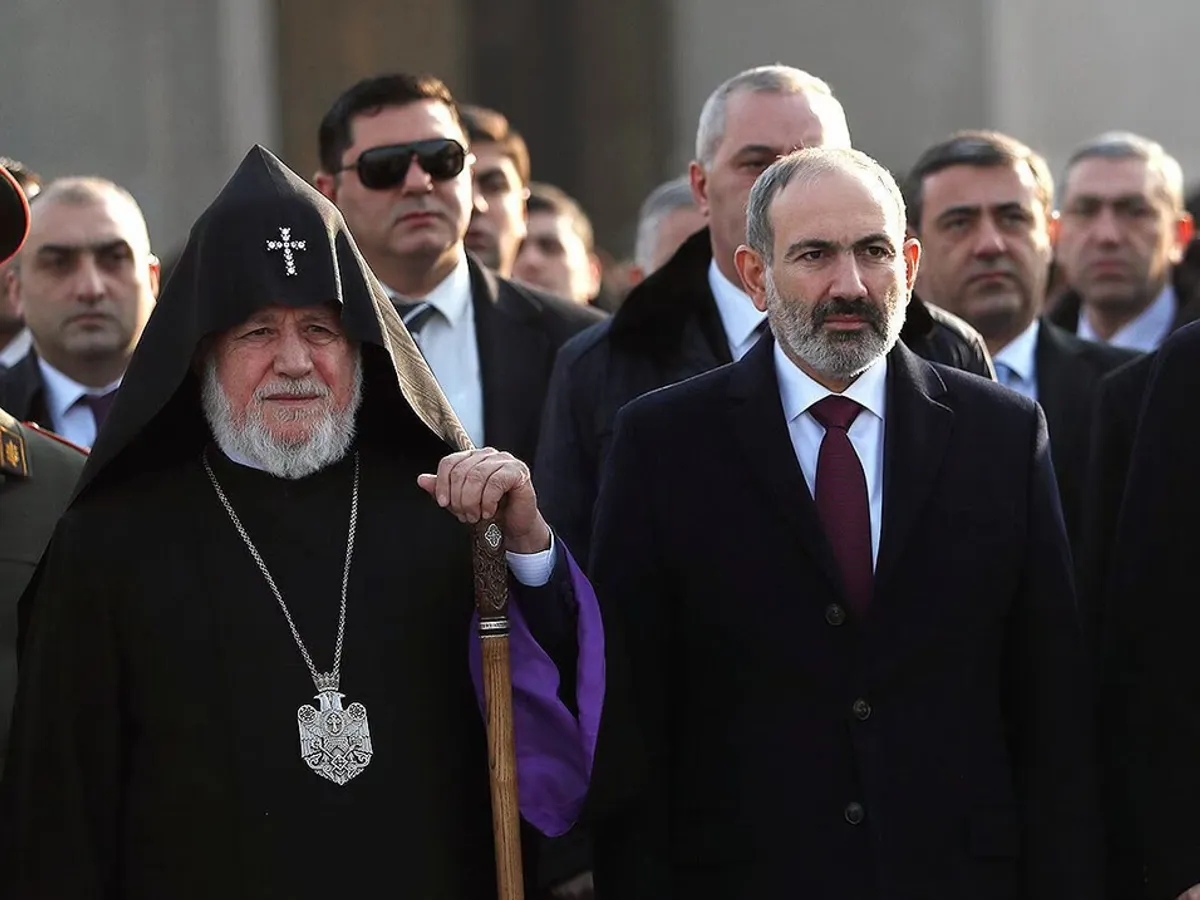
Armenia has seen a wave of criminal cases involving leading opposition figures and the Armenian Apostolic Church.
The muted reaction from Western rights groups and media is sharpening questions over whether the same human-rights standards are being applied across the South Caucasus.
In the summer of 2026, Armenia saw a series of events, any one of which would have become an international story had it happened elsewhere in the region. Over the course of three months, almost every prominent opposition politician in the country faced criminal prosecution. On 6 June, the day before the parliamentary elections, criminal proceedings were launched against six candidates from the Strong Armenia Alliance, the main rival to Nikol Pashinyan’s party; at least four were placed in custody. The alliance nevertheless finished second, winning 23.29% of the vote and 28 seats. On 6 July, Prosperous Armenia leader Gagik Tsarukyan was detained: a court remanded him in custody on charges of large-scale fraud and money laundering, with tax evasion charges added later. On 25 August, former president and Armenia Alliance leader Robert Kocharyan and his son Sedrak were detained; searches were conducted at several dozen addresses, including the home of Kocharyan’s younger son, MP Levon Kocharyan. On 27 August, a court authorised his arrest.
On 1 September, former finance minister Gagik Khachatryan was carried out of his home on a stretcher and taken in that condition to investigators and then to court. According to his lawyers, he suffers from a severe spinal condition and was in severe pain while being transported. The following morning, the 71-year-old former minister was remanded in custody for two months.
At the same time, Armenia is witnessing a criminal prosecution of the head of the Armenian Apostolic Church that is unprecedented in the country’s modern history. The case arose against the backdrop of Pashinyan’s open conflict with Karekin II, who had called for the prime minister’s resignation and held the government responsible for the loss of Karabakh.
The trigger was an internal Church personnel dispute: the Catholicos removed a bishop as head of a diocese and did not comply with a secular court ruling ordering his reinstatement. On 29 January, criminal proceedings were opened in connection with the actions of the Church leadership; on 30 January, six members of the Supreme Spiritual Council were charged; and on 14 February, criminal proceedings were launched against the Catholicos himself, who was also barred from leaving the country.
Reuters reports that Pashinyan accused the Church—without presenting any public evidence—of acting as a tool of foreign powers, particularly Russia. The Church rejects the accusation. Civil society organizations and opposition representatives have, in turn, raised questions about the independence of the judiciary and the political nature of the criminal prosecution.
There are, however, close institutional and historical ties between the leadership of the Armenian Church and Russia. In 2022, Vladimir Putin awarded Karekin II the Order of Honor for his contribution to the development of Russian-Armenian cultural and humanitarian relations, according to Armenpress.
And on September 4, 2026, Karekin II received a delegation in Etchmiadzin led by Metropolitan Anthony of Volokolamsk, the head of foreign relations for the Moscow Patriarchate. According to the Armenian Apostolic Church, he conveyed Patriarch Kirill’s greetings and the Russian Orthodox Church’s support for the Armenian Church, stating that the interference of secular authorities in its internal affairs is unacceptable.
Western rights groups and media remain largely silent
Neither human rights organisations nor leading Western media outlets have examined these developments in any substantive way. Human Rights Watch and Amnesty International, normally attentive both to the persecution of opposition figures and to pressure on religious leaders, have not issued a single statement on them.
Furthermore, the BBC, CNN, The Guardian, and The Independent gave limited coverage to these cases, even though they had published numerous reports on the human rights situation in Azerbaijan. Since September 1, there have been no news reports on the situation in Armenia.
The question remains whether the extent of international coverage and reactions is proportional to the gravity of the events that took place in Armenia.
Trump administration points to progress in the South Caucasus
The South Caucasus peace process is credited to the Trump administration as one of its achievements. On 4 September, the president shared an article by special envoy Steve Witkoff in which peace in the South Caucasus was presented as a concrete result of that policy and as an example of a pragmatic approach to the region. The Trump administration’s broader policy is meeting with an increasingly cool reception in European capitals, and the divergence is evident not only in public statements. During the same weeks, criticism of Baku in the European press has intensified, though unevenly: British publications account for most of it, and as the volume of coverage has grown, the Karabakh issue has returned with it.
EU signals a “new phase” with Azerbaijan
Azerbaijan remains under sustained criticism and media pressure. Yet the European Union’s official position looks different: on 4 September, EU Ambassador to Azerbaijan Marijana Kujundžić spoke of a “new phase” in relations with Azerbaijan, an intensification of political dialogue and preparations for a new framework for bilateral cooperation. The selectivity whereby some violations become international stories while others pass without comment cannot be explained by the nature of the events themselves. A uniform standard would mean that the response is determined by the gravity of what has happened, rather than by who is responsible for it .