Armenia Hosts UN Environmental Forum amid gaps in its own ecological policies
Armenia is hosting the UN biodiversity conference while declaring its ambition to join the European Union. The experience of Central and Eastern Europe shows how far its record falls short of its promises.
On 19 October the seventeenth Conference of the Parties to the Convention on Biological Diversity (CBD COP17) opens in Yerevan. For the first time, governments will carry out a global review of progress in implementing the Kunming-Montreal Global Biodiversity Framework (KMGBF). Europe has a stake in the outcome. Armenia is part of the Eastern Partnership, launched at the initiative of Poland and Sweden, and in 2025 its parliament passed a law starting the country’s accession process to the European Union. The natural comparison, then, is with Central and Eastern Europe, whose countries inherited much the same legacy in the 1990s: mines, untreated sewage, denuded hillsides.
For more than a year, observers have asked whether Armenia could be not merely the venue for the summit but an example to others. In May 2025 the ecologist Ruben Khachatryan wrote in The Revelator that the country was “far from a model of environmental stewardship”; later that year, in a piece for EVN Report, he identified the gravest threat as policies that put mining above environmental protection. A Heinrich Böll Foundation report pointed to “competing interests with the mining and energy sectors”, and in July Hetq wrote that on the eve of COP17 Armenia was “making ambitious promises that are hard to believe”. Just days to go, the record is discouraging.
Cyanide mining: Armenia takes a different path
A quarter of a century ago a dam burst at Baia Mare in Romania, sending cyanide-laced waste down the Tisza and the Danube all the way to it’s delta. In the aftermath, the Czech Republic, Germany and Hungary banned cyanide leaching. Romania later abandoned mining at Roșia Montană: the site was placed on UNESCO’s World Heritage List, and in 2024 an arbitration tribunal dismissed the investor’s multibillion-dollar claim.
Armenia, by contrast, took a stake. The state owns 12.5% of Lydian Armenia, the company preparing to open a mine at the Amulsar deposit near the spa town of Jermuk. Since September 2025 the government’s representative in the company has been Gnel Sanosyan, a former minister and a member of the ruling party’s board. According to the economy minister, the launch was scheduled for September, on the eve of the conference, with the gold to be extracted using a sodium cyanide solution.
Yet, as a paper published by the UN in Armenia noted, only 9 of 24 mining companies submitted environmental monitoring reports for 2024. Armenia’s neighbours responded to environmental disasters by banning cyanide. Armenia became a shareholder in a cyanide mine, in an industry where most companies do not even report on their environmental impact.
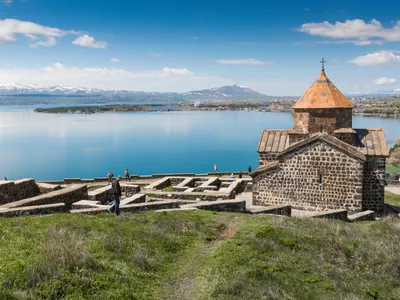
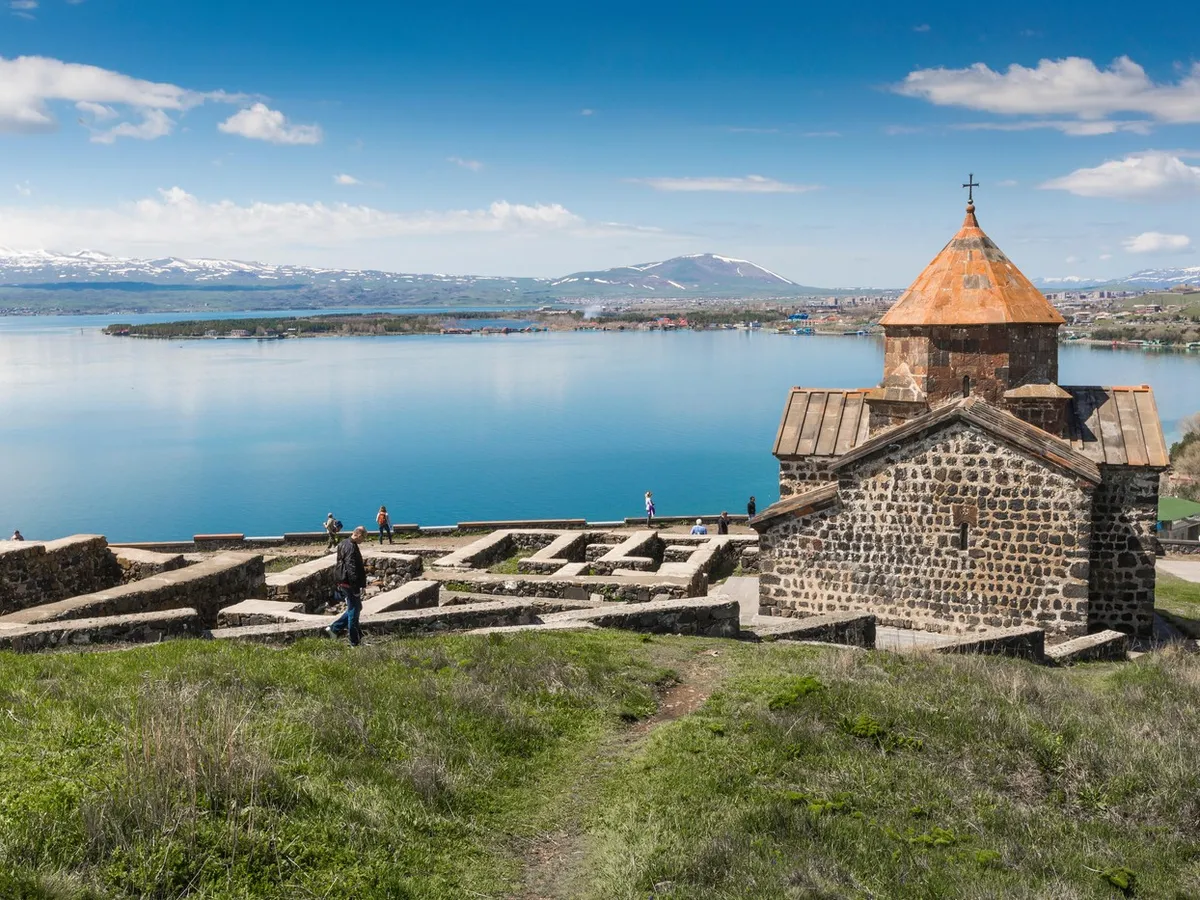
Lake Sevan still receives untreated sewage
Armenia’s water was in trouble long before cyanide. Hungary halted the eutrophication of Lake Balaton by cutting phosphorus loads and restoring the Kis-Balaton wetland; across the European Union more than 90% of urban wastewater is treated to a common standard. In Armenia, according to EVN Report, only about 8% of urban wastewater received mechanical treatment in 2021, while less than 1% received biological treatment. The EU and Germany allocated almost €6 million to EU4Sevan, a programme to protect Lake Sevan whose objectives included wastewater treatment. Yet in a 2024 programming document Brussels was still reporting that untreated sewage was polluting the lake. The treatment plants around Sevan remain mechanical only; biological treatment is still just a government promise, included in its programme for 2026–2031. Sevan remains the clearest failure.
Uncounted forests and species on the brink
With forests, even the baseline is uncertain. Poland has raised its forest cover from 21% in 1945 to more than 29%. Armenia promises to nearly double its own by mid-century, yet its last forest inventory dates from 1993. The pledge to double Armenia’s forests rests on figures that do not exist and on planting that runs at a third of the plan.
Armenia protects 13% of its territory and aims for 20% by 2030, while the global framework calls for 30%. The European Union protects more than a quarter of its land, and Poland, Slovakia, Bulgaria and Croatia already protect more than 30% of theirs. The European bison shows what sustained conservation can achieve. By 1927 none remained in the wild; the species was restored from twelve founder animals, and today its largest free-ranging population, some 1,000 animals, lives in the Białowieża Forest. Armenia, according to EVN Report, has only eight to thirteen leopards left. The country remains far even from its own target, itself less ambitious than the global one, and its rarest species remain on the brink of extinction.
Environmental violations without consequences
Rules are only as good as their enforcement. In the European Union, an operator whose activity poses an imminent threat to the environment must take preventive measures before any damage occurs. In Yerevan in July, Hetq reported that soil from preparations for the COP17 site was spilling into the Hrazdan Gorge, filling the riverbed and damaging trees – even though, only a month earlier, the city authorities had presented protected status for the gorge as one of their COP17 commitments. The environmental inspectorate acknowledged the dumping but closed the case: the trees had not withered and the riverbed had not changed, so there was no “measurable damage”. In 2025 the inspectorate recorded 3,303 violations, 30% more than the year before. Yet even an obvious case on the conference’s doorstep came to nothing.
Funding the summit while conservation falls short
Money is short, too. EU institutions have agreed to devote 10% of the Union’s annual budget spending to biodiversity in 2026 and 2027. Armenia’s action plan for 2026–2030 will require about $960m, according to a preliminary estimate by the UN Development Programme (UNDP), and 93% of that sum has yet to be found. A government decision puts the cost of the conference itself at around $25m. The money was found for the conference. For nature, almost none.
The environmental tests on Armenia’s route to Europe
Over the past year the questions facing the host have only multiplied: a cyanide mine scheduled to open on the eve of the summit; untreated sewage in Lake Sevan; forests uncounted since 1993; a case over soil dumped at the conference site, closed without consequence; a conservation plan with nine-tenths of its funding missing. Armenia has failed to become an example.
Poverty is not the explanation. Time and again, when environmental rules have collided with the interests of industry or influential owners, the rules have given way. The shores of Lake Sevan were built over for years. As far back as 2019, Artur Grigoryan, a former head of the environmental inspectorate, warned of corruption schemes in the mining sector. Today the state itself holds a stake in a cyanide mine.
The global review will not punish Armenia for any of this: under the convention’s rules, it is conducted “in a non-punitive manner”. EU accession negotiations will be different. There, the questions will be whether wastewater treatment plants have been built, whether forest inventories are in place and whether environmental enforcement actually works. A country that passes a law bringing it closer to the Union while repeatedly sacrificing nature to private interests is taking a hypocritical route to Europe. Central and Eastern Europe made that journey in earnest.
Borislav Sandov, international environmental expert, former Deputy Prime Minister for climate policies, Minister of Environment and Water of Bulgaria